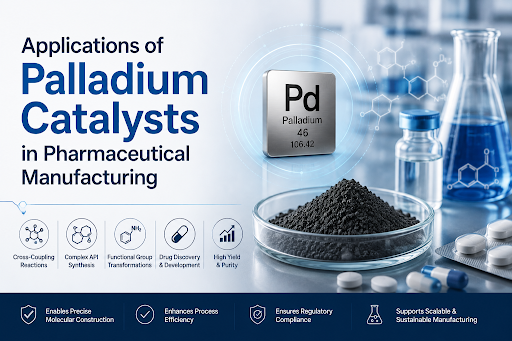
Chemical reactions that have the ability to produce complicated molecules are essential in modern pharmaceutical manufacturing. Catalytic chemistry is an aspect involved in chemical reactions to enable them to occur in realistic conditions and assist in the formation of particular chemical bonds. The commonly available catalysts that are significant in organic syntheses include Palladium Catalysts. The palladium catalysts are known to be involved in cross-coupling, hydrogenation, and C-H bond activation, among others.
Azaricta Research Labs (ARL) provides a wide range of precious metal catalysts such as palladium and rhodium catalysts, phosphine ligands, and other products in the chemistry field. This company has many other chemicals in its product line, like building blocks, boronic compounds, API intermediates, specialty chemicals, and other materials relevant to pharmaceutical and chemical research.
Why Palladium Chemistry Matters in Drug Manufacturing
Pharmaceutical molecules are often composed of numerous functional groups and intricate structural arrangements. Their preparation would entail the execution of several synthetically challenging procedures. Catalysis involving palladium is able to assist in the formation of carbon-carbon and carbon-heteroatom bonds essential in the synthesis of the pharmaceutical precursors and active ingredients.
The first advantage is in the versatility of palladium chemistry. The choice of various palladium species and catalysts will depend on the substrate used, the reaction path, the selectivity required, and the particular needs of the process.
Cross-Coupling Reactions for Complex Molecules
One of the main uses of palladium in organic chemistry is the cross-coupling reaction. Here, two fragments of molecules can be connected, which makes it possible to obtain rather complicated molecules based on the available precursors.
Azaricta Labs produces palladium-containing compounds, which are involved in the following cross-coupling reactions: palladium(II) acetate can be used in the following reactions: Heck, Suzuki–Miyaura, Buchwald–Hartwig, Stille, Sonogashira, and Negishi coupling. The carbon-carbon and carbon-nitrogen bonds formed during these reactions can be useful while designing pharmaceuticals and their intermediates.
The commonly used cross-coupling reactions are:
- Suzuki–Miyaura coupling: used for the formation of carbon-carbon bonds between aryl or vinyl halides and boronic acids.
- Buchwald–Hartwig amination: forms carbon-nitrogen bonds between suitable aryl halides and amines.
- Heck reaction: helps to form carbon-carbon bonds between aryl or vinyl halides and alkenes.
- Sonogashira coupling: connects aryl or vinyl halides with terminal alkynes.
- Negishi and Stille coupling: provides another way of constructing carbon-carbon bonds.
In the process of developing complicated molecules in the laboratory, pharmaceutical chemists have more than one option due to the reactions described above.
Hydrogenation and Hydrogenolysis in Pharmaceutical Synthesis
One interesting subject in relation to pharmaceutical chemistry is the use of supported Palladium Catalysts for hydrogenation and hydrogenolysis. Pd/C is palladium, which is dispersed on activated carbon; it is used for the reduction of unsaturated substances and some functional groups in organic chemistry.
Azaricta Labs produces Palladium 10% on Carbon (Pd/C) with about 55% water content. Among the uses of the product described in its description, there are: hydrogenation, hydrogenolysis, reduction of olefins and nitro groups, and debenzylation.
This type of transformation could be very helpful during the synthesis of pharmaceutical drugs where a certain functional group should be reduced or where it is necessary to remove a protecting group. Different substrates and different conditions could give quite a wide range of behavior. Therefore, selection of catalyst and control of reactions still plays an important role in process development.
C–H Activation and Advanced Organic Transformations
Palladium chemistry is also applicable for direct functionalization of C-H bonds. This type of transformation could allow finding new ways of constructing complex molecules and, perhaps, could allow reducing the number of steps in some syntheses.
For example, Azaricta Labs presents Palladium(II) Benzoate as a catalyst of C-H bond activation and annulation reactions for the synthesis of organic compounds. This reagent is also said to be a precursor of other palladium catalysts, and it is suitable for pharmaceutical and research purposes.
For those scientists developing molecules that are difficult to synthesize, this kind of chemistry may open new synthetic routes for the formation of chemical bonds.
The Role of Catalyst and Ligand Selection
However, selection of a suitable palladium compound is just the first step in the development of the reaction. Different ligands can greatly affect the performance of a palladium catalyst, its efficiency, and its ability to be applied for a certain coupling reaction.
Azaricta Labs has developed a separate Ligands portfolio where different phosphine compounds such as BINAP, RuPhos, Xantphos, triphenylphosphine, and tricyclohexylphosphine can be found.
For instance, its Bis(tri-tert-butylphosphine)palladium(0) is stated to be an extremely effective catalyst in Suzuki, Negishi, Heck, and Buchwald-Hartwig reactions. This serves as an illustration of how palladium complexes and ligands can be used in accordance with the needs of pharmaceutical chemists.
Supporting Pharmaceutical Research Beyond Catalysts
Sometimes, catalyst choice forms a part of an overall developmental process. There may be other requirements for pharmaceutical researchers regarding starting materials, intermediates, analytical services, and custom synthesis processes.
Azaricta Labs has Custom Synthesis, which includes building blocks and intermediates, impurity synthesis and characterization, peptide-related chemistry, and catalysts and reagents. They can provide multi-step synthesis, purification, and scale-up from mg to kg quantities.
This company also supplies Analytical Services, such as impurity characterization, purity assessment, NMR, GC-MS, HRMS, GC, and HPLC. These kinds of analytical services can be used together with synthetic chemistry for research, development, and quality control.
From Reaction Development to Reliable Supply
When choosing a catalyst for use in pharmaceutical production, it is not just enough to discover the reaction that works in the lab. Researchers will have to pay attention to issues such as catalyst purity, reaction performance, ease of handling, scalability, availability, and compatibility with the rest of the process.
According to Azaricta Labs, its portfolio includes more than 10,000 chemicals in different scales, from milligram to bulk, flexible packing, custom synthesis, quality controls and worldwide delivery. Among these chemicals are catalysts, Boronic Products, building blocks, API intermediates, specialty chemicals, and other chemicals used in research.
Building Better Synthetic Routes with the Right Chemistry Partner
The uses of Palladium Catalysts have applications in various stages of pharmaceutical and fine chemicals synthesis that include but are not limited to cross coupling, hydrogenation, C-H activation, and many others. The flexibility of palladium catalysts offers an opportunity to access difficult molecules through diverse reaction pathways while helping the formation of valuable intermediates for drugs.
For organisations seeking a reliable supplier of catalysts and other chemical solutions, Azaricta Labs can be considered a viable option. Being one of the few companies having palladium and rhodium catalysts, phosphine ligands, API intermediates, custom synthesis services, and analytics services all in one place, Azaricta Labs offers a variety of complementary chemistry solutions. It is because of the unique combination of the range of products, quality, research, and supply capability that Azaricta Labs stands out as the right choice for chemistry solutions.