
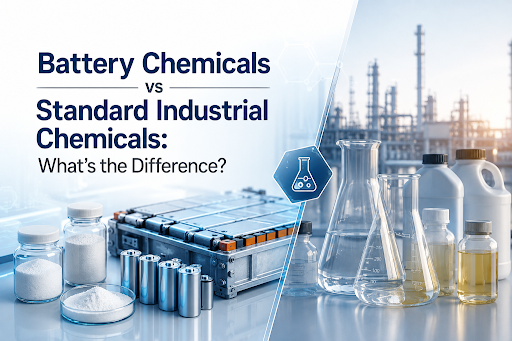
The increased demand for energy storage has also created a need for materials that are capable of performing well in batteries. Although chemicals utilized in battery research and manufacturing are often used in other applications in the industry, there can be quite a lot of differences between the specifications of the chemicals based on the application. Battery Chemicals are chosen not only due to their chemical composition but also due to their purity, humidity tolerance, particle size, and electrochemical properties. These factors are essential for understanding battery material selection.
What Makes Battery Chemicals Different?
The key distinction here is in the intended purpose for the chemical substance. While standard industrial chemicals are good enough for uses related to manufacturing, processing, coating, catalysis, and general chemical synthesis, battery materials form a part of the highly controlled electrochemical system where even slight changes in material properties can influence its performance.
For example, Azaricta Labs provides a wide range of battery-specific materials, such as lithium silicon alloy powder, cobalt metal powder, iron powder for thermal batteries, molybdenum-containing materials, and nano copper powder. It is clear from the variety of offered products that battery materials can differ in terms of chemical composition and function instead of being a single type of chemical.
Purity Is More Than a Percentage
One of the most crucial aspects to take into account when comparing battery-grade chemicals and normal industrial chemicals is purity. While a substance with a 99% purity rating provides just one side of the story, the kind and degree of impurities should also be considered, especially if it is intended to use the material in an electrochemical setup.
According to the application at hand, one should consider such parameters as:
- Trace metal impurities
- Moisture and water content
- Particle size and distribution
- Chemical composition
- Form of the material
- Stability in storage and handling conditions
- Batch-to-batch consistency
Specifications for the products manufactured by Azaricta Labs are examples of the approach. Trace metal assay and mesh-size specifications are provided for the lithium silicon alloy powder, whereas metal content and particle size specifications are provided for nano copper powder. All these details offer a more complete picture of the material than its purity rate.
Purity Standards Depend on the Application
Purity standards do not refer to any one standard that must be applied to all chemicals. The appropriate specification would depend on the end application of the chemical, as well as its composition, manufacturing process, and performance specifications.
In one case, the chemical will be specified as an industrial reagent, and the specifications will be completely appropriate to its role in the process. But when evaluating a material as an electrode, electrolyte, additive, or thermal battery, there might be specifications related to the electrochemistry.
Azaricta Labs describes Fluoroethylene Carbonate (FEC) as a lithium-ion battery electrolyte additive. This chemical specification includes purity, storage temperature, moisture sensitivity, density, and storage because those properties are relevant.
Different Chemicals, Different Battery Functions
Materials used in batteries need not belong to one single group of chemicals. Various types of compounds and materials may perform entirely different functions in energy storage devices.
The following are some examples of products from the range of Azaricta Labs:
- Lithium Hexafluorophosphate (LiPF₆): Used as electrolyte salt in lithium-ion batteries with regard to ionic conductivity and electrochemical stability.
- Fluoroethylene Carbonate (FEC): Used as an electrolyte additive for solid electrolyte interphase formation at electrodes.
- Cobalt Metal Powder: Used in battery cathode materials and industrial uses.
- Lithium Silicon Alloy Powder: Used in advanced energy storage devices and important in terms of energy density and charging.
- Iron Powder: Used in thermal battery applications as fuel material.
The above range also brings about one point: one type of material may be used in battery applications as well as non-battery ones. What changes here is the grade and suitability required for the application.
How Standard Industrial Chemicals Fit Into the Picture
Standard industrial chemicals can be used for various applications such as in research, manufacturing, pharmaceuticals, material sciences, and chemical processes. They can come in different grades according to their applications.
Azaricta Labs offers a more comprehensive list of products that go beyond battery materials. Their product list comprises Analytical Reagents, Metal Powders & Turnings, Catalysts, Phosphine Ligands, Peptide Coupling Reagents, Specialty Chemicals, and perovskite solar cell-related materials and solar cell research.
The comprehensive list of products is very helpful for research teams that perform chemistry in many fields. It is also clear from the above discussion that choosing a chemical just by its name or standard industrial grade is not enough. The specification of the chemical must be suitable according to the application.
Quality, Documentation and Handling Matter
The quality of chemicals has strong links with documentation and proper handling. The product pages on the website of Azaricta Labs include documentation specific to each product, including purity level, appearance, conditions for storage, packaging, safety instructions, and application information. SDS, COA, and analytical data documentation are available for several products.
When the material is moisture-sensitive or reactive, the way of its storage becomes especially important. Lithium silicon alloy, for instance, is said to be very sensitive to moisture and air and is recommended to be stored under inert gas. LiPF₆ is also listed as moisture-sensitive.
Thus, assessment of a supplier includes not only comparison of the prices and purity levels. Product documentation, consistency, packaging, storage needs, and technical data can become criteria for choosing appropriate chemicals for a specific project.
A Better Match Between Material and Application
The distinction between battery chemicals and regular industrial chemicals basically depends on the fitness for purpose. Battery applications can call for very strict control of the physical and chemical properties of materials because materials are used in an electrochemical system. Regular industrial chemicals are still very vital in several applications, but their specifications can be tailored to other purposes.
For researchers, scientists, and organizations involved in energy storage solutions, choosing the appropriate chemicals that have well-defined specifications is one way of ensuring reliable processes for research and development purposes. With its battery materials collection, extensive line of specialty chemicals, as well as technical data about products, Azaricta Labs is definitely the best place for you to go to if you are looking for a reliable source of Battery Chemicals.