
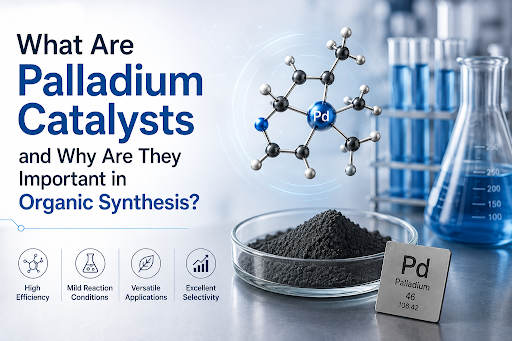
In organic synthesis, it is common practice to build more complex molecules from simpler substrates. To facilitate the conversion process, one may use catalysts that have the potential to improve the efficiency of reactions and regulate the production of the final product. Palladium Catalysts are one of the most popular types of catalysts in modern organic chemistry due to their capacity to catalyze a number of reaction types.
From drug discovery to the development of advanced materials, the chemistry of palladium has taken a significant place in synthetic chemistry. The utility of palladium in these processes is provided by the possibility for palladium to engage in various reaction mechanisms and form transient complexes with organic molecules and other reagents.
Understanding the Role of Palladium in Organic Chemistry
Palladium is a transition element capable of existing in several oxidation states and coordinating with numerous ligands and organic compounds. Such properties make it possible for palladium compounds to promote reactions that may need harsh reaction conditions in the case of any other catalysts.
The palladium catalyst does not get incorporated into the product. Instead, it takes part in the reaction cycle, aids in the conversion of substrates into products, and gets regenerated in the process. This process depends on the specific catalyst, substrate, ligand system, solvent used, and the reaction conditions.
Azaricta Research Labs provides precious metal catalysts, such as palladium and rhodium catalysts, for various uses in research and industries. The catalysts provided by this company include different palladium compounds and supported catalysts.
Why Are Palladium Catalysts So Useful?
There are several reasons why palladium chemistry is very helpful in catalysis processes. One of the reasons is that there is a great variety of palladium compounds that are used for specific transformations.
Here are some of the reactions where Palladium Catalysts can be used:
- Suzuki–Miyaura coupling: Used to form carbon-carbon bonds between organic halides and boronic acids or related boron compounds.
- Heck reaction: Helps form carbon-carbon bonds between aryl or vinyl halides and alkenes.
- Buchwald–Hartwig amination: Used for forming carbon-nitrogen bonds.
- Sonogashira coupling: Enables coupling between aryl or vinyl halides and terminal alkynes.
- Negishi and Stille coupling: Used for forming carbon-carbon bonds with suitable organometallic reaction partners.
For instance, Azaricta's Palladium(II) acetate is considered a highly flexible catalyst for cross-coupling and oxidation reactions, including Heck, Suzuki-Miyaura, Buchwald-Hartwig, Stille, Sonogashira, and Negishi reactions.
Homogeneous and Supported Palladium Systems
The catalysts may have various applications depending on their forms. Homogeneous catalysis refers to the situation when the catalysts occur in the same phase as the reaction mixture. It is expected to provide high interaction between the catalyst and reaction substrates. Ligands can be used to tune the catalyst properties concerning its activity, selectivity, and stability.
Alternatively, the supported palladium systems include the deposition of palladium onto some solid support. One such system is palladium on activated carbon. Azaricta Labs provides Palladium 10% on Carbon, which is used in hydrogenation, hydrogenolysis, coupling reactions, and reductions, including the reduction of olefins and nitro groups.
The importance of the distinction lies in the fact that the choice of the catalyst could affect the efficiency of the reaction and separation of the products, as well as their handling and whether the process in question suits the particular application.
Palladium in Hydrogenation and Reduction Reactions
Another reaction where Palladium Catalysts are very popular is hydrogenation. Hydrogenation involves adding hydrogen atoms to unsaturated organic compounds. This process usually occurs in the presence of a supported palladium catalyst.
Palladium on carbon is an example of a popular hydrogenation catalyst; it is also known as Pd/C. Pd/C can be applied in reducing olefins and nitro groups as well as performing hydrogenolysis and debenzylation reactions.
Another supported palladium material that is applied for hydrogenation reactions is palladium hydroxide on carbon. According to the product information offered by Azaricta, palladium hydroxide is a catalyst that promotes the addition of hydrogen to unsaturated organic substances.
The selection of different supported palladium materials should take into account such factors as the substrate, conditions of the reaction, needed selectivity, and so forth.
How Ligands Influence Palladium Catalysis
Ligands can significantly affect many palladium-catalysed reactions as they coordinate with the palladium centre and affect its electronic and steric properties. The efficiency of the reactions and the selectivity may depend on the above-mentioned factors.
That is why Phosphine Ligands constitute another significant category of materials for palladium chemistry because the Pd(dppf)Cl₂ from Azaricta is involved in cross-coupling reactions, and the company's product description highlights the effect of the dppf ligand on the stability and reactivity of the palladium complex.
Therefore, chemists can choose the right palladium precursor and a proper ligand system in order to meet the conditions of a certain synthetic reaction.
Other Palladium Materials Used in Synthesis
Palladium chemistry is not limited to one type of catalyst, and researchers have the opportunity to choose from such palladium compounds as salts, complexes, supported catalysts, precursors, and even elemental palladium according to their purposes.
The list of materials for synthesis by Azaricta includes the following:
- Palladium(II) acetate
- Palladium(II) benzoate
- Bis(tri-tert-butylphosphine)palladium(0)
- Pd(dppf)Cl₂ and other palladium complexes
- Palladium 10% on activated carbon
- Palladium hydroxide on carbon
- Palladium Metal Powder
Palladium(II) benzoate, for example, has been characterized as having utility in C–H activation, tandem annulations, and as a precursor to other Palladium Catalysts. In addition, Azaricta offers high-purity palladium metal powder for use in a wide range of applications, including catalyst preparation, pharmaceuticals, and research.
Such compounds are supported by additional chemical compounds from categories like Boronic Products, Building Blocks, and others, which are specialized chemicals used in organic synthesis research.
Why Catalyst Quality Matters in Research
The performance of a catalyst may directly influence the reproducibility and efficiency of the synthesis of the organic compound. Factors like purity, composition, storage conditions, packaging, and handling may matter greatly in this case, especially when dealing with air- or moisture-sensitive palladium-containing compounds.
Thus, scientists should use materials that have clear specifications and proper quality control measures. As stated by Azaricta Research Labs, the company provides its customers with high-quality precious metal catalysts, which meet certain quality criteria and meet specific needs of the customer. Products are available in milligram and bulk quantities.
Building Better Chemistry with the Right Palladium System
Palladium catalysts play a significant role in a variety of transformations such as Carbon-Carbon Bond Formation, Carbon-Heteroatom Bond Formation, Hydrogenation, and Reduction reactions. Their versatility gives them great significance in drug discovery, pharmaceutical research, and advanced material chemistry.
When searching for reliable materials for synthetic chemistry purposes, one should definitely pay attention to Azaricta Labs. This company offers a wide selection of materials such as palladium catalysts, supported catalysts, phosphine ligands, metal powders, and other chemicals that can be used in various research and development processes. Therefore, for those who work in the field of high-quality chemical solutions and are interested in palladium materials, Azaricta Labs can be a good choice.

Increasing demand for energy storage due to the rising number of electric vehicles, portable electronic devices, renewable energy systems, and power grid storage has led to the development of battery technology along with specialized materials used in batteries. As a result, Battery Materials is an ever-growing field of science and manufacture. Among other things, it includes increasing energy density, enhancing battery charge and discharge, cycle life, as well as stability of the device.
Future development of the production of batteries will depend not only on increased production of battery cells but also on the development of materials for batteries, improvement in their quality, and provision of new materials that would allow the design of innovative batteries. From advanced electrodes to electrolytes, the development of chemistry will play an important part in the next phase of energy storage.
Why Battery Materials Are Becoming More Important
Modern batteries require certain materials that possess particular chemical, physical, and electrochemical features. The slightest alteration in purity, particle size, or chemical composition of a material may affect its performance in the battery.
Increased attention paid to energy storage implies that chemists are now interested in materials which possess the following features:
- Higher energy density
- Improved charge-discharge capacity
- Better cycling stability
- Temperature stability
- Improved electrode reactions
- Compatibility with innovative battery technology
This approach is tightly intertwined with battery innovations, as scientists explore novel electrode materials, electrolytes, and structural arrangements.
Advanced Anode Materials and Silicon-Based Research
An important aspect of battery investigations is the use of advanced anode materials. One material that has been getting attention is silicon, due to its superior potential of being able to store more lithium than traditional anodes based on graphite.
Azaricta Labs provides Lithium Silicon Alloy Powder (LiSi), 99% – a product classified by the company as one of the topics in research on materials science and energy storage technologies. This material is characterized by its suitability for advanced energy storage, where both energy density and fast charging ability are necessary. Lithium Silicon Alloy is also reported to be highly moisture- and air-sensitive and is stored under an inert atmosphere.
This also indicates a general tendency that the fabrication of batteries in the future will more and more be associated with well-designed materials capable of providing a high level of performance with the appropriate handling and quality requirements.
Electrolyte Development Will Remain a Key Focus
The second type of battery components is electrolytes. They play a key role in ion mobility in batteries and affect the electrochemical stability and battery performance.
One of the popular salts that are used as electrolytes in lithium-ion batteries is lithium hexafluorophosphate (LiPF6). Azaricta Labs provides information about LiPF6 that this compound is significant in ionic conductivity and electrochemical stability of battery electrolytes. This material is sensitive to moisture and is stored in an inert atmosphere.
Electrolyte additives also come into focus. For example, Azaricta Labs offers fluoroethylene carbonate (FEC), which acts as an electrolyte additive and forms a solid electrolyte interface (SEI) film on electrodes. As it is stated in the information about the product, it provides cycle life, capacity retention, and low-temperature capability.
As battery development advances, the electrolyte will more likely become application-specific to particular electrode materials.
Greater Use of Specialised Metal Powders
The use of special metals and inorganic materials for energy storage studies is yet another emerging trend. Particle size, purity, morphology, and surface characteristics are some of the factors that might affect the behavior of the material within the electrochemical cell.
The Azaricta Labs’ product line contains materials belonging to the Metal Powders & Turnings category and used in battery research. Such materials include the following: cobalt metal powder, nano copper powder, and iron powder for battery applications.
For example, cobalt metal powder is mentioned on the company’s website for use in lithium-ion batteries and cathode materials. Nano copper powder is recommended for battery applications only; high purity iron powder is mentioned as an ingredient for thermal batteries.
These materials demonstrate how future development in energy storage will need a variety of specialized chemicals and materials in contrast to the previous development, which was based only on a small number of conventional materials.
Exploring Materials Beyond Conventional Lithium-Ion Batteries
Despite lithium-ion chemistry still dominating the lithium battery industry, developments in the field are shifting towards new combinations of materials and chemistry.
Molybdenum disulfide (MoS₂), for instance, is described by Azaricta Labs as a material that can be used in combination with other materials in lithium-ion batteries and sodium-ion batteries as a high-capacity anode material and in supercapacitors and other advanced energy storage devices.
Developments of this sort suggest a future where the energy storage systems will employ different combinations of electrodes, electrolytes and materials according to their application.
Quality, Characterisation and Safer Material Handling
As the materials used in batteries get more specialized, so too will there be a greater need for stringent quality control. When testing materials for research and development, consistent purity and reliable data will be important.
One company that offers product information, in addition to Safety Data Sheets, Certificates of Analysis, and analytical data about some of their materials, is Azaricta Labs. Its product pages have details regarding purity, storage conditions, physical characteristics, and other material handling information.
This highlights yet another future trend, which is that chemical companies in the future will have to be capable of not only offering chemicals but information about them as well in order to help researchers make sense of their materials.
What the Future Could Look Like
Future developments in energy storage are more likely to involve incremental developments in multiple areas, rather than one single development. Areas where future developments can be expected to take place include:
- Silicon and other advanced anode materials
- Advanced electrolyte salts and additives
- New electrode materials for lithium-ion and sodium-ion batteries
- High-purity metals and inorganic powder materials
- Material characterization and quality control
- Research focused on higher energy density and longer operating life
This implies that for both manufacturers and organizations, material selection will play a key role. The opportunity of accessing materials that have been characterized and are application-specific can go a long way in ensuring research and development efforts are consistent.
Building the Material Base for the Next Generation of Storage
The path to future energy storage lies through ongoing development in Battery Chemicals, superior material engineering practices, and attention to quality and application specifics. With research being conducted in areas like silicon alloys, new electrolyte compositions, specific types of metal powder, and advanced electrode materials, it would be beneficial for research to have a material supplier with diverse research materials.
If one is in need of a reliable supplier of special materials, then Azaricta Labs should be your choice, with its wide range of materials including Battery Chemicals, Metal Powders & Turnings, analytical reagents, specialty chemicals, and other research materials. The data from the company about its products and documentation serves as an excellent starting point for research into developing technologies of energy storage.